Can You Read ‘Correctly’?
It is difficult to be perfect. Likely impossible. But I’ve been wondering if you’d want to be perfect, anyway.
On the 400th anniversary of William Shakespeare, there was a unique performance inspired by the most famous part of the play ‘Hamlet’.
“To be, or not to be, that is the question:”
In this performance, a young actor, Paapa Essiedu, appears first, delivering the line as:
“TO be, or not to be, that is the question”
Following this, a plethora of renowned modern actors appear on stage, each advising the younger performer how exactly to deliver this iconic line. It’s worth a watch - but short of giving the game away, I thought of how this can apply to any line.
Let’s connect that thought with the real world.
As a child in 2006, I listened to audiobooks a lot.
One day, I decided to read the along while listening to Harry Potter, narrated by Stephen Fry.
I was already familiar with Stephen Fry’s style and storytelling. He’s an an extraordinarily good (and accurate) narrator, with his interpretation of words giving the sense that he’s read not only the coming sentence, but indeed the whole page following, and judges so well how to weigh each word or phrase.
But when I read alongside, all of a sudden I had my own reading voice going on, and sometimes (much to my surprise) it wasn’t perfectly in line with one of the most intelligent actor-narrators in the industry. This was only on a small percentage of the lines, but still, I wondered how and why this could be. It got me thinking; could there be two ways of reading a line equally “correctly”? Or can my internal reading voice be wrong more than I realise?
English is a language like many where emphasis is important but not always essential for understanding. Other languages like Cantonese is delivered with respect to tones, where a different inflection turns one word into an entirely different word. (In Mandarin, the sound ‘ma’ can have five different meanings based on tone and character.) In some languages, emphasis is remarkably similar across a sentence and has less importance for comprehension (or so I have read, and I would gladly learn better).
So, we are in a place of flexibility with English, but nevertheless with some distinct rules of thumb: inflection upwards towards the end of a question; often a relative weight on nouns; emphasis on prepositions if they change the narrative flow. Yet though we have all this flexibility, day-to-day speech seems surprisingly consistent between people. Especially between actors on narrative passages, though each will have their style, much of the delivery is similar.
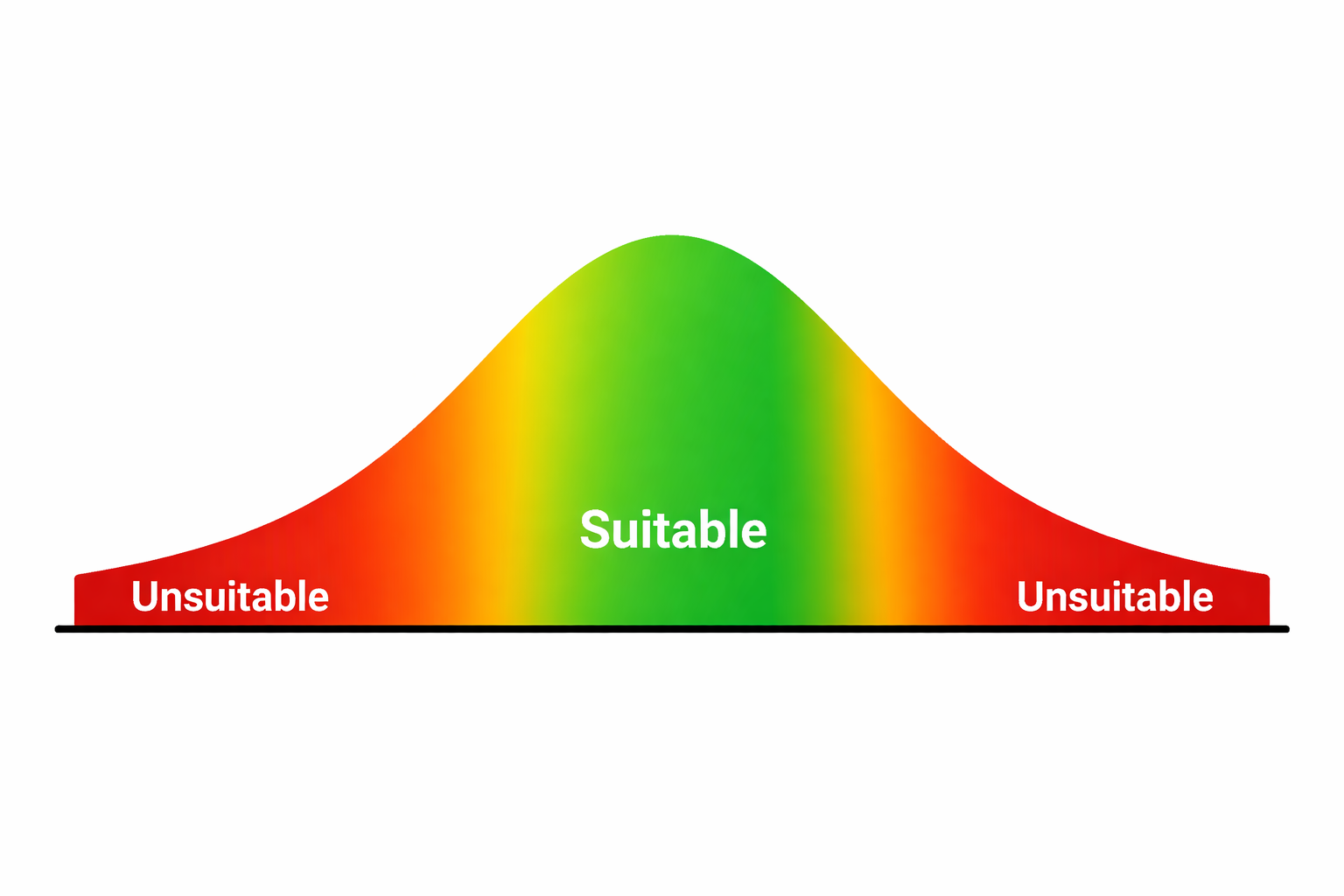
A simplistic view of how a sentence can be read. Too far at either extreme is unsuitable for the majority, and a reader is in service to the audience and the author.
If there is so much in common, there must be a distribution of probabilities on how to read any given sentence (which is affected by the context and place in the story). And if you could survey the whole population speaking that language, there would be a winner in terms of which version of the reading communicates what the author wanted the most accurately. You could just ask the author, but again they’d be one viewpoint only. While I’ve heard a number of authors do fantastic readings of their own work, and multiple recent drivers have encouraged more to do the same, it remains the majority who would like to narrate their own work, and the minority who can do so as well as or better than a dedicated narrator.
If there does exist a bell curve for how a line ought to be read, an AI option is now in the mix. Why not? If there are actions repeated, they can be measured, they can be computed, they can be replicated. Yet, as I discussed in my last post, an AI voice remains one I find difficult to listen to for more than a minute, and the knowledge that it isn’t real… somewhat [totally] spoils it for me at the moment.
The issue with the AI for an audiobook is that is there’s a ‘correct’ way of reading something, it will choose that way every single time. It plays it safe. No risk. It isn’t in the calculations, the programming, the probabilities. In good unique human writing, you get sentences and plots which are unique enough that the machine hasn’t seen something quite like it in quite enough of its data. And so the AI still makes mistakes - not mistakes as in a misread of the actual words, but a misinterpretation of the weight of the words, which is what we began this post with. If you give AI “to be, or not to be, that is the question:”, would you expect it to be compelling?
So, we return to the original question: can you read ‘correctly’? Well, yes, you could. You could do it so correctly so often that it stops being a reading and turns into a mechanical parroting exercise. So what if Stephen Fry and my internal voice different sometimes? It keeps it interesting, it keeps it real. And to be honest, where we differed, I could always come around to his interpretation. It is very rare, and yet almost inevitable, that in a whole long book some genuine error will slip through - like a typo. A “read-o”?
And yet I’m glad it sometimes does. Because an imperfect reading is real, it adapts, and gives a version of the story that makes sense. And an extraordinary reading, hailed by people as “Wow, that was just perfect” is likely charismatic, which means it has identity, and so again will not appeal to all.
One again, it seems we cannot be perfect. Reassuringly though, you probably wouldn’t want perfect anyway.