Adapting to the Familiar
Morgan Freeman, legendary actor with an objectively recognisable voice (The Shawshank Redemption; cast as ‘God’ in the films Bruce Almighty and Evan Almighty), was recently asked about his voice on the Jimmy Fallon talkshow.
Jimmy Fallon: “Do you think you have an amazing voice?”
Morgan Freeman: “No.”
The audience: Erm… hehe… what?
This is the clip below:
You can hear the surprise from the audience; that the possessor of a rich, characterful, instantly recognisable baritone voice should think absolutely nothing of it. It got me thinking.
It is said that familiarity breeds contempt, but more often I think it just breeds a tendency to not be surprised. Having lived with his voice for decades, there’s little it does that would probably surprise Morgan. He uses it as one tool in his acting repertoire, and as an actor would probably appreciate if people commented on his acting choices and delivery and expressions rather than the innate quality of his voice. Physiologically, he has no control over it, after the effects of suitable acting and vocal practice.
I’m sure would be very conscious if something were to go wrong with it. But he wouldn’t be going around the house idly talking away. It is very different to the imagination of someone who thinks “Well, if I had your voice I’d just talk all day!”
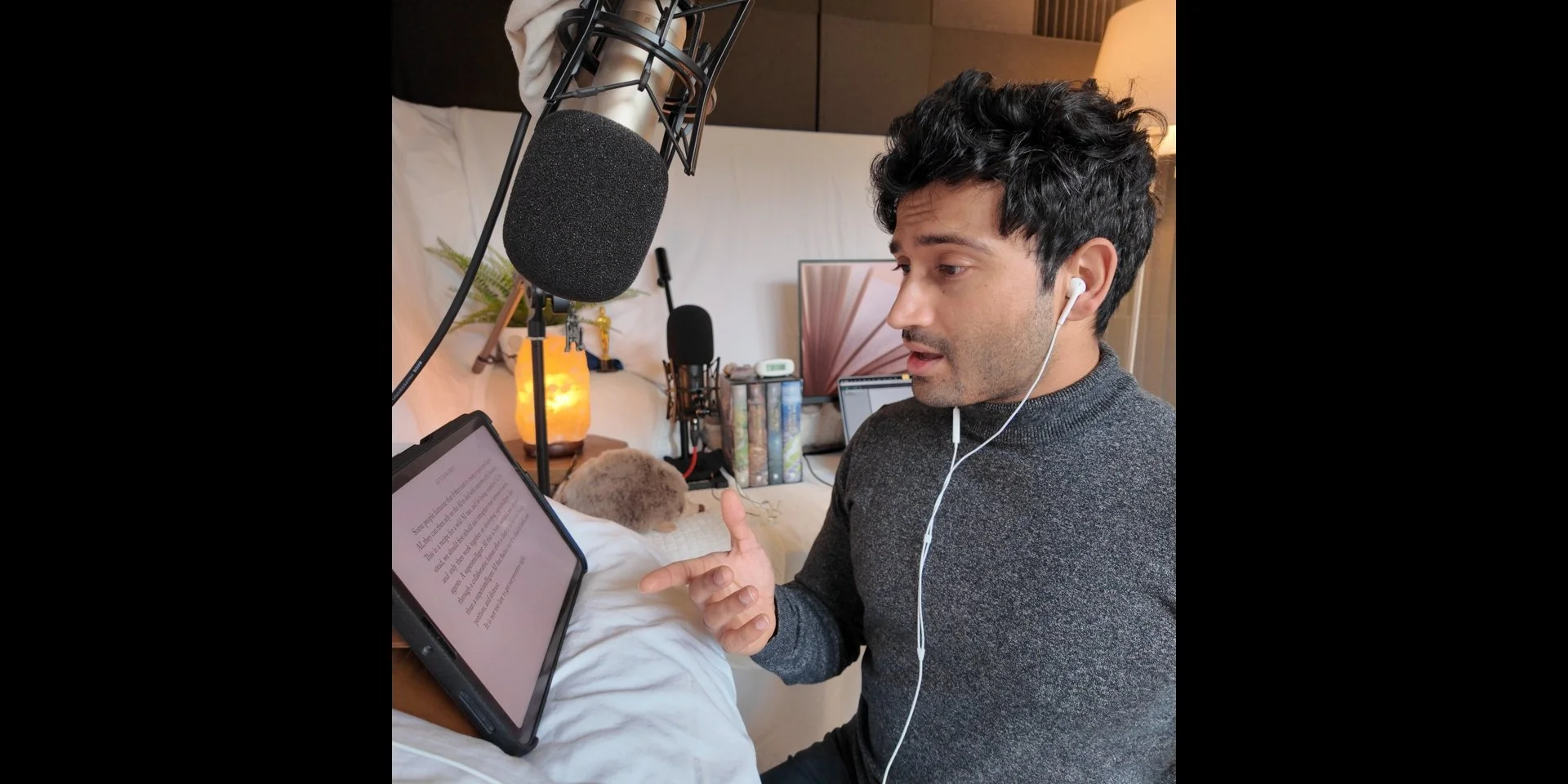
I’m very familiar with my voice. But I don’t think I value it enough; I’m not grateful often enough for it. I just keep expecting it to be there as it has always been, and somehow not lose any quality.
Sometimes, of course, we do talk all day. All week if recording a big book! The voice is evolved to be able to be used all day and all week - notice how crying babies don’t suffer vocal fatigue… perfect technique! For most of us though, tiredness will set in at some point, but it depends a lot on conditioning and practice. For you, perhaps a month, a week, a day, or an hour is the limit. (Though, if it’s an hour, consider why.)
But I don’t normally talk that much, because I stop being intrigued by what the voice sounds like after a little while, because I’ve literally heard it all before. I then tend to start singing to keep myself entertained, and at some point it becomes familiar again.
I want to change this.
I want to be grateful for having a voice that does everything I ask of it. From wanting to change to any other voice when mine broke as a teenager and lost all the singing range and tone, to this point of not wishing to swap it for anyone else’s (yes, even Morgan Freeman’s).
Just like the body rejoices when it gets the right kind of exercise, and unlocks untapped stores of energy in repsonse and rebuilds and recovers faster, the voice is an adaptive thing. It likes to be taken care of, cherished by giving it attention, the right exercise. Watch how it grows stronger, more resilient, more elastic. Watch how new possibilites unlock, and how your range of choices as an artist, a communicator, a human being, expand.
Not exactly rocket science… be grateful, train the voice and surprise yourself with its power. What if you’re trained already?
Complete familiarity will lead to the same training, and the same conditioning. The human body is an adaptation machine. It changes to survive and thrive in the environment and stimuli that it experiences. It cannot shrink or grow immediately, or change beyond its genetic ability, but over years we can see cumulative changes stack up for huge differences in almost every area.
Not only physically, but mentally also. And this is the sense I am most curious about today. Can one adapt to see the voice that one has in this moment, fully and from zero? From zero meaning that any voice is beautiful in its own way. And in doing this, one marvels at this gift, and with renewed vigour gives it new attention and care, so it can soar to new places.
Where will these new places be?
Only you can find out for yourself.
I will find out for myself.
Morgan Freeman will have already found out for himself. And I’m sure that, if he wants, he can do so again.